
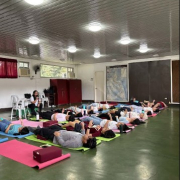
In 2019, after receiving a grant from the Templeton World Charity Foundation (TWCF), FriendlyCare Foundation, Inc., in collaboration with the Centre for Mindfulness Studies (CMS) in Toronto and the UP Diliman, developed and piloted a mindfulness-based program. Originally named Mindfulness for Compassion and Well- being, the program was designed to enhance prosocial qualities such as empathy, compassion, and altruism, aligning with TWCF’s goals of promoting character development and fostering emotional resilience among young people. The program was initially targeted at college-aged participants from UP Diliman and the University of the Cordilleras, aiming to integrate mindfulness- based practices into students’ daily lives. The course was later aptly renamed “Mindfulness for Health and Well- Being” when it was offered as a PE elective for university students.
Key figures, including then- UP Chancellor Michael L. Tan and Dean Carlos Francis Diaz of the College of Human Kinetics, played instrumental roles in bringing the MHW course into UP Diliman's PE curriculum. Their leadership facilitated the integration of mindfulness into the university’s educational offerings, ensuring the program reached a diverse student population from various colleges across the university. Initially envisioned as a program that could also be incorporated into other fields, such as psychology, sociology, National Service Training Program (NSTP), or life skills education, PE ultimately emerged as the ideal platform to introduce the program to the widest range of students. By embedding MHW into the PE curriculum, the course became a mandatory component for all students, providing them with essential tools for both physical and well- being. In UP Diliman, offering the course through the College of Human Kinetics as a PE elective proved to be the most efficient and inclusive way to introduce it to a broad student audience. As PE is a requirement for all students, this approach ensured that the course reached a large and diverse group of participants across various disciplines.
One of the course’s primary objectives is addressing entrenched gaps in mental health education, skills- building, help- seeking behaviors, and the destigmatization of mental health issues. MHW takes significant steps toward filling these gaps by providing students with essential mindfulness tools that help them manage stress, regulate emotions, and develop greater self- awareness. Additionally, the course fosters a deeper understanding of kapwa (a Filipino concept of shared humanity), encouraging students to extend their compassion and empathy beyond themselves to their peers and communities. Many participants have reported that the course has positively influenced their ability to connect with others and has inspired them to become more active in helping their communities.
Now in its twelfth semester as an officially offered PE course, MHW has proven its value within the university. The course not only equips students with mindfulness practices that support their physical and mental well- being but also aligns with the evolving role of PE as a holistic discipline that addresses both physical health and emotional resilience. The success of MHW at UP Diliman demonstrates that mindfulness, when integrated into a university setting, can have a lasting impact on student health and community engagement.
As of today, MHW program remains to be an elective in the PE2 curriculum of UP Diliman where students from various year levels are able to enlist and experience the course. It has been sustained since the RCT trials in 2020, and is now on its sixth year of implementation. Two professors from the UP College of Human Kinetics (CHK) faculty have also been training in becoming a facilitator of the program to continue the delivery of the course in the university.